
Knee pain · 7 min read
Why Your Knee Hurts Going Downhill (and What Actually Fixes It)
The climb feels fine. It is the descent that lights up the front of your knee, and by the time you reach the car you are walking sideways down the last stretch. Here is what that pattern usually means.
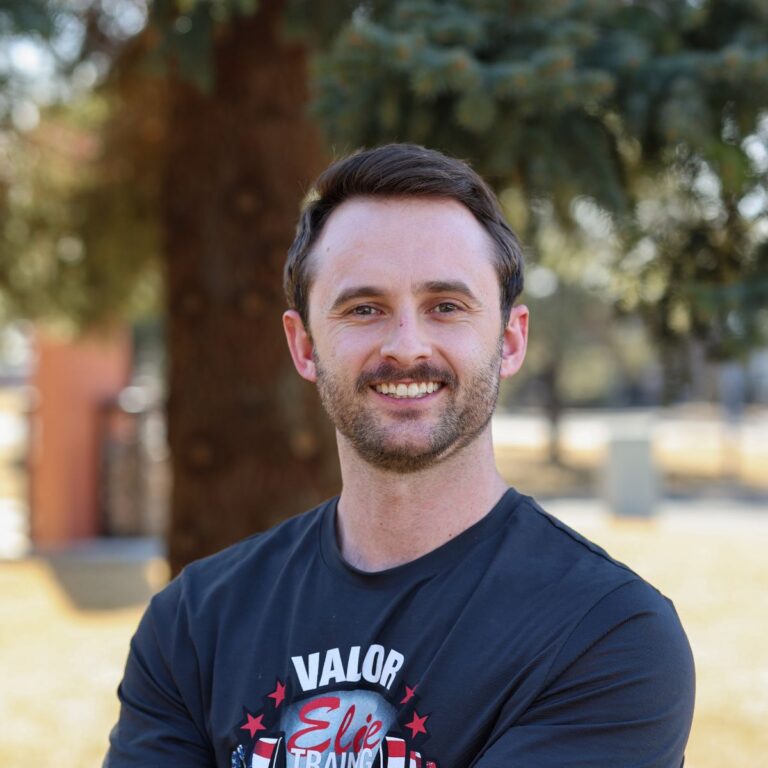
Written and medically reviewed by Dr. Alec Tramblay, DC
Chiropractor & owner, Fort Collins · September 20, 2026
The short answer
Knee pain going downhill is usually a capacity problem, not damage. Descending asks your quad to work as a brake, and that loads the kneecap joint far harder than climbing does. When the front of your knee hurts on the way down, it typically means the quad and hip cannot yet absorb the braking force your hike or run is asking for. The fix is rarely rest alone. It is loading the knee progressively so it tolerates more, while you adjust stride, cadence and downhill volume in the meantime.
Why downhill hurts when uphill does not
Going up, your quad shortens as it pushes you up the trail. Going down, the same muscle has to lengthen under load to stop your body from collapsing into each step. That braking contraction produces much higher forces through the joint between your kneecap and thigh bone, and it does it thousands of times over a long descent.
So a knee that is completely happy on a climb can be furious twenty minutes into the way back. Nothing changed about the knee. What changed is the demand.
What usually causes it in active adults
In the clinic, downhill knee pain almost always traces back to one of a few things, and often more than one at once.
- —A jump in downhill volume: a big trail day, a new race, or the first real hiking weekend of the season after a winter of flat ground.
- —Quad and hip strength that has not kept up with the miles, so the muscles fatigue and the joint takes more of the force.
- —A long, overstriding gait on descents, which increases braking force with every step.
- —Limited ankle or hip motion, so the knee absorbs movement the joints above and below should be sharing.
- —Fatigue late in a hike, which is why the pain often appears on the last mile rather than the first.
What it probably is not
Most people assume the worst: cartilage is gone, the meniscus is torn, arthritis has arrived early. That is usually not what is going on, especially if the pain came on gradually, sits around the front or underneath the kneecap, and settles within a day or two.
It is also worth knowing that imaging findings like cartilage wear and small meniscus changes are extremely common in people with no knee pain at all. A scan on its own rarely explains why your knee hurts on descents and not on stairs, or why it hurt in July and not in May.
What to change this week
You do not need to stop hiking or running. You need to lower the per-step braking demand while you build the knee back up.
- —Shorten your stride and take quicker steps on descents. Smaller steps mean less braking force per step.
- —Use trekking poles on steep descents. They genuinely offload the knees over long downhills.
- —Break long descents up. Two shorter downhill efforts with a break between them is easier on an irritated knee than one continuous grind.
- —Keep training the things that do not hurt. Uphill, flat ground, cycling and lifting usually stay in.
- —Start loading the quad directly: split squats, step-downs, and slow controlled tempo work two or three times a week.
The part most people skip
Rest calms an irritated knee down. It does not raise the ceiling on what that knee can handle, which is why the pain comes straight back on the next big descent.
Strength is what raises the ceiling. The knee needs to be exposed to controlled braking work in the gym, so the trail stops being the hardest thing it does all week. That means loading the quad through range, then progressing to step-downs and eventually downhill-specific work.
This is the whole reason rehab here is built around a barbell and a plan rather than a table and a schedule.
- —See how we treat knee pain and meniscus injuries
- —/services/knee-pain/
When to get it assessed
Some knee pain deserves hands-on evaluation rather than another week of trying things.
- —The knee swells within hours of activity, or stays swollen.
- —It locks, catches, or gives way underneath you.
- —Pain came on suddenly with a twist, pop or fall rather than gradually.
- —It has not improved at all after three to four weeks of modified training.
- —It hurts at night or at rest, not only during activity.
Common questions
Should I stop hiking if my knee hurts going downhill?+
Usually not. Shorten your stride, use poles, cut the length of the descent and keep the uphill and flat work in. Complete rest tends to lower your capacity further, so the same hike hurts just as much when you return to it.
Do trekking poles actually help knee pain?+
Yes, particularly on steep or long descents. They take a meaningful share of the braking load off the knee, which is often enough to keep you hiking while strength work catches up.
Is downhill knee pain a sign of arthritis?+
Rarely, on its own. Pain that appears only on descents and settles within a day or two is far more often a load tolerance issue. Arthritis usually brings morning stiffness, pain across more activities, and a more gradual long-term pattern.
How long does it take to fix?+
Most people feel clearly better within two to four weeks of modifying volume and starting real strength work, and get back to full descents in roughly eight to twelve weeks depending on how long it has been going on.
Where can I get this looked at in Fort Collins?+
Tier 1 Performance and Rehab treats knee pain for hikers, runners and lifters at 3350 Eastbrook Dr Ste 120 in Fort Collins, CO, serving Loveland, Timnath, Windsor and Wellington. The first step is a free discovery call.
Related conditions we treat
Still dealing with this after a few weeks?
Book a free discovery call. We will tell you what is going on, whether this is something we treat, and what a plan would look like — before you commit to anything.
Book Free Discovery Call